









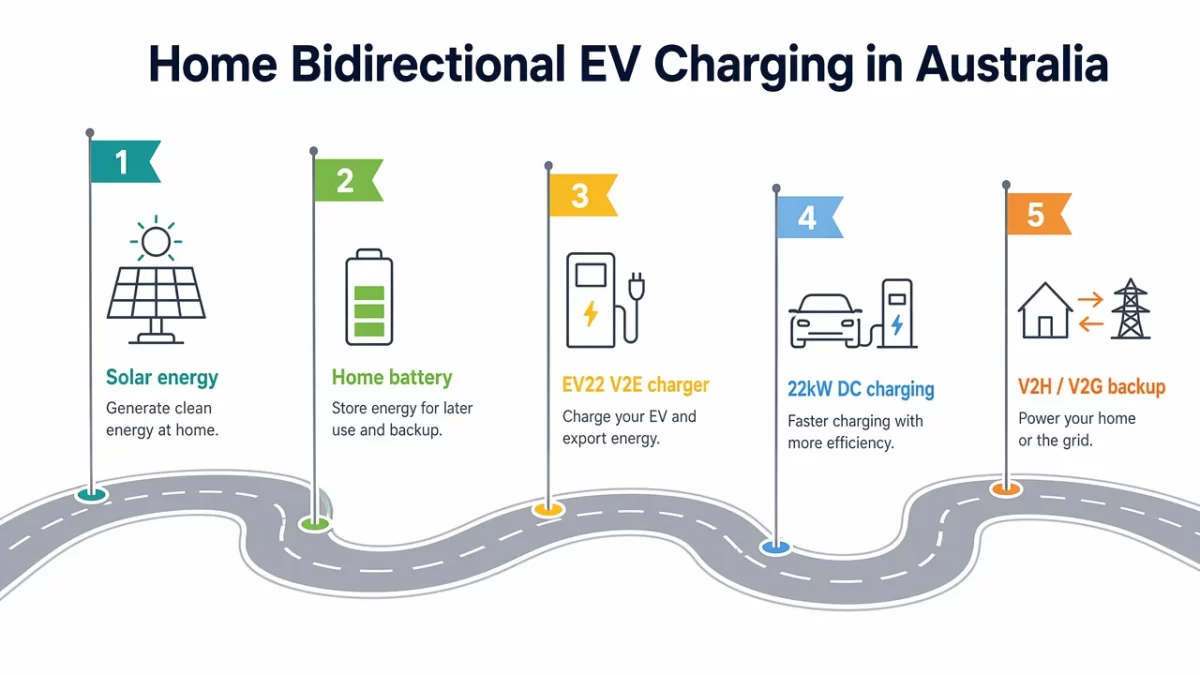
What's a bidirectional EV charger?
A bidirectional EV charger is a charger that moves power in both directions. A normal charger only sends electricity into your car. A bidirectional one also lets the car send power back, so your EV can run your home or the grid, working like a big battery on wheels. While charging, the charger turns electricity into the high-voltage DC power your battery holds; while discharging, it turns that DC back into the AC your home or the grid can use.
The two ways it works: V2H and V2G
V2H (vehicle-to-home): here the EV powers the house through a bidirectional charger. You bank cheap solar energy during the day, draw on it at night, and keep the lights on when the grid goes down.
V2G (vehicle-to-grid): this one feeds energy back to the grid when demand peaks, and the right electricity plan pays you for it. It needs approval from your network operator first, because sending power back into the grid has to meet their safety and connection rules.
AC vs DC bidirectional chargers
Two hardware designs exist, and the difference comes down to where the conversion between AC and DC happens. In an AC charger, the car's own onboard converter does that work, so the wall unit stays simpler and cheaper. In a DC charger, the conversion happens inside the wall unit itself, which sends and pulls DC straight from the battery. That design makes DC units more efficient and powerful.
Available bidirectional EV chargers in Australia
Compare bidirectional EV charger specifications side-by-side. This table lists the home V2H and V2G charging solutions currently available, in testing, or launching in Australia.
| Charger | Brand | Max power | Charging | Connector | V2H / V2G | Australian availability |
|---|---|---|---|---|---|---|
| SigenStor DC EV Module | Sigenergy | Up to 25kW | DC | CCS2 | Yes / Yes | On sale with the SigenStor battery system; V2G awaits firmware and CEC certification |
| Quasar 2 | Wallbox | Up to 11.5kW | DC | CCS2 | Yes / Yes | Sold overseas; not yet CEC-approved in Australia |
| IQ Bidirectional EV Charger | Enphase | Up to 11.5kW | DC | CCS2 (expected) | Yes / Yes | Expected to reach Australia during 2026 |
| EV22 V2E | ESYsunhome | Up to 22kW | DC | CCS2 (also CCS1 and GB/T) | Yes / Yes | Coming to the Australian market |
Status quo of the bidirectional EV charger in Australia
Bidirectional chargers are legal to install in Australia now, but the market is small and most models are only part-way through approval.
The rules changed in 2024, when the inverter standards AS/NZS 4777.2 and 4777.1 were updated to cover two-way charging, making it legal to connect one to the grid nationwide. The standards themselves sit with Standards Australia.
Legal to connect is one thing; certified is another. Every bidirectional charger needs Clean Energy Council approval before installation, and most models are still working through that step. Right now, only a handful are on sale or open for pre-order, while the rest sit in testing or run under limited state exemptions. On top of that, the local network has to approve the connection before any charger can switch on.
For where this is heading, ARENA's national roadmap for bidirectional charging sets out the plan.
ESYsunhome's bidirectional EV charger
Many Australian homeowners install solar expecting their EV to become part of the home's energy system. In reality, charging can still be slow and grid-heavy, and discharging is often missing. That is the gap the EV22 V2E is built to close.
ESYsunhome comes from solar, inverter and battery technology, so we designed the EV22 V2E as part of a complete home energy setup. It is a 22kW DC charger because AC charging is fine for overnight top-ups, while 22kW DC can add useful range to a compatible EV in under an hour. It also supports two-way energy flow through CCS1/CCS2/GBT.
The charger offers two modes. Fast Mode combines available solar, grid and battery power to deliver up to 22kW. Green Mode gives priority to solar and battery energy, helping homeowners leverage the advantages of clean energy.
Paired with an ESYsunhome ESS, the EV22 V2E can also help keep essential loads running during a blackout. The charger, battery, and solar system work together as one connected setup.
In everyday life, it will give homeowners more control over how they charge: faster charging when time matters, and more solar-powered charging when reducing grid use and running costs matter most.
FAQs
Do all EVs work with a bidirectional charger?
No. The EV, charger and connector all need to support bidirectional charging. In Australia, the setup also needs network approval before V2H or V2G can be used.
Will bidirectional charging affect my EV battery?
It should not be a major issue if managed properly. The system limits charge and discharge levels, but you should still check the EV maker's warranty terms first.
Do I still need a home battery?
It depends. ESYsunhome’s bidirectional EV DC charger must pair with a home three-phase ESS.
Conclusion
For Australian homeowners, bidirectional EV charging is moving from concept to early rollout. The practical decision is not only which charger looks strongest on paper; the EV, connector, home ESS, network approval and installation path all need to work together.
For projects that need 22kW DC charging, V2H/V2G capability and solar-plus-battery integration, review the EV22 V2E charger against your home energy setup before confirming local connection requirements.
EV charging and home battery resources
Bidirectional charging works best when it is considered together with solar storage, backup loads and installer support.