









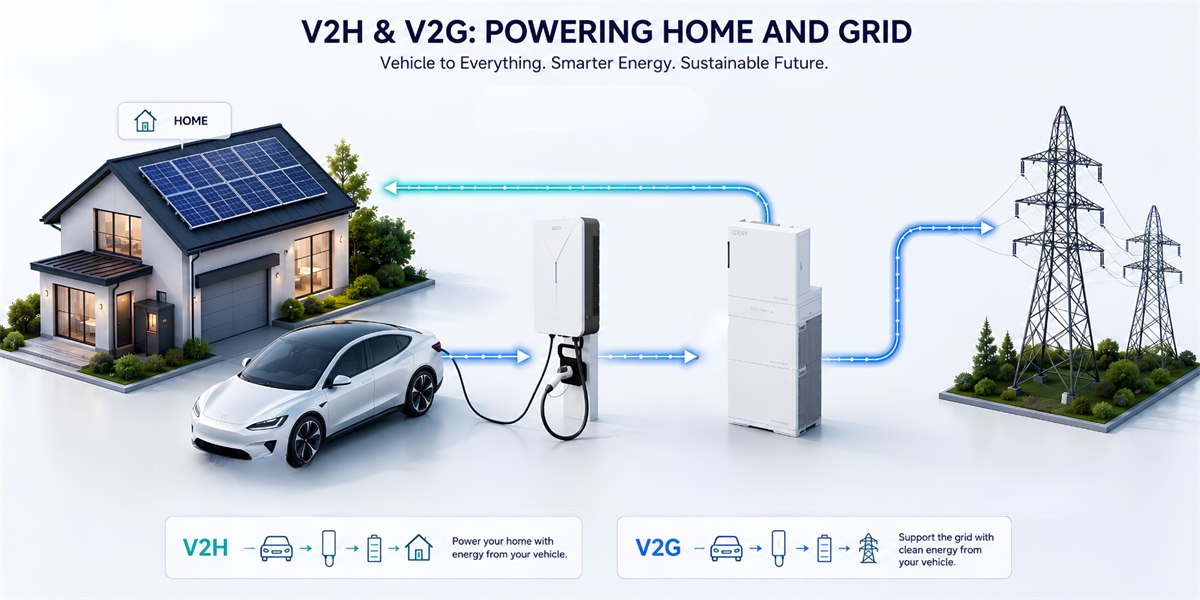
A bidirectional EV charger is a charger that moves electricity both ways. It charges your electric car like any normal charger, but it can also pull energy back out of the car’s battery to power your home or send electricity to the grid. A standard charger is a one-way street: grid to car. A bidirectional EV charger is a two-way street: grid to car, and car back to grid or home. In short, it turns your EV into a large battery on wheels.
This is where V2H and V2G come in. They sound technical, but they just describe where the power goes when it leaves the car, to your home, the grid, or something you plug in. We’ll walk through each one below.
How a Bidirectional EV Charger Works: V2H and V2G
A bidirectional charger works by converting electricity in whichever direction you need. When charging, it turns the grid and solar into DC power to fill the battery. When discharging, it does the opposite, pulling DC out of the car and converting it back into AC that your home or the grid can actually use. A control system sits in the middle, deciding when to charge, when to discharge, and how much.
From there, the only thing that changes is where that outgoing power goes. Your car can power your house (V2H) or send electricity back to the grid (V2G). Each one behaves a little differently in practice, as this closer look at V2G and V2H shows, and we’ll walk through all two below.
V2H (Vehicle-to-Home)
With V2H, your car powers your house. During a blackout, your EV acts as a backup battery and keeps the essentials running. It can also feed stored solar into your home in the evening so you buy less from the grid. This mode needs a bidirectional charger and a way to safely isolate your home from the grid during an outage.
V2G (Vehicle-to-Grid)
V2G goes a step further and sends power back to the public grid. Parked EVs help utilities smooth out peak demand, and in the right program you can get paid for it. This is the most demanding mode, since it needs a bidirectional charger, a vehicle approved for it, and a formal interconnection agreement with your utility.
| Mode | Where power goes | Need a bidirectional charger? | Typical use |
|---|---|---|---|
| V2H | Car -> home | Yes | Backup power, evening self-consumption |
| V2G | Car -> grid | Yes (plus utility approval) | Grid support, earning from tariffs |
What Is a V2E Charger?
“V2E” is a term you’ll run into on product pages, and it causes confusion because the “E” gets used in different ways:
- In marketing, V2E usually stands for Vehicle-to-Energy or Vehicle-to-Everything, a catch-all name for a charger that can do both V2H and V2G.
- In some technical documents, it means Vehicle-to-Equipment, which is just powering one specific piece of gear.
Either way, most product listings and search results file V2E under the broader V2X family, which is the general term for bidirectional charging. So when you see “V2E” on a spec sheet, take it to mean a charger that can power your home and feed the grid, then check the details for exactly which modes it actually supports.
When I’m helping someone read a spec sheet, I will tell them to look at the details of the specs. That’s exactly why we built our EV22 V2E bidirectional DC charger to tell you straight what it does. It handles up to 22 kW of DC power and supports both V2H and V2G, spelled out plainly. And because it’s DC-coupled, it works alongside your home storage system, so it can lean on your solar first or pull from solar, grid, and battery at once when you want to charge faster. And that DC-coupled design pays off in daily use, cutting your grid bills by charging on solar and keeping the lights on when the power goes out.
When Do You Need a Bidirectional EV Charger?
- Frequent power cuts. If your grid drops often, the car can act as a backup source and keep you running through an outage (V2H).
- You already have solar. Daytime energy that would otherwise be wasted gets stored in the car and used after dark.
- Time-of-use pricing. Charging when electricity is cheap and discharging when it’s expensive turns your car into a money-saver. Our dynamic tariff guide for home BESS breaks down how that arbitrage actually pays off.
- Cutting grid reliance. Pairing the charger with a home battery energy storage system lets the EV top up whatever the battery can’t cover.
There’s no need for one if your car can’t send power back out, or if you don’t have solar and pay one flat rate for electricity. One thing trips people up, so keep it in mind: your car and the charger both have to support the same mode, and the carmaker often has to switch it on in the car’s software first. A charger that says “V2G ready” still won’t do V2G if your car isn’t set up for it.
FAQs
How long can a bidirectional EV power a house?
It depends on battery size and home load. Essential loads may run for many hours or longer, but heating, cooling, and cooking appliances drain the battery much faster.
What extra equipment do I need besides the charger?
You usually need backup control equipment. A V2H setup may require a transfer switch, gateway, meter, or critical-load panel to keep the home and grid safely separated.
Can it work with solar during a blackout?
Yes, if the system supports anti-islanding operations.
Will V2H leave my EV without enough range?
Not if you set a battery reserve. Most systems let you keep a minimum charge level so the car stops discharging before it affects your next trip.
Conclusion
A bidirectional EV charger turns an electric car into a useful energy source for the home, the grid, or both. V2H is mainly for backup power and home energy use, and V2G is for exporting power to the grid. Before choosing one, check three things: whether your EV supports the mode you need, whether your utility allows grid export, and whether the charger is properly certified.