









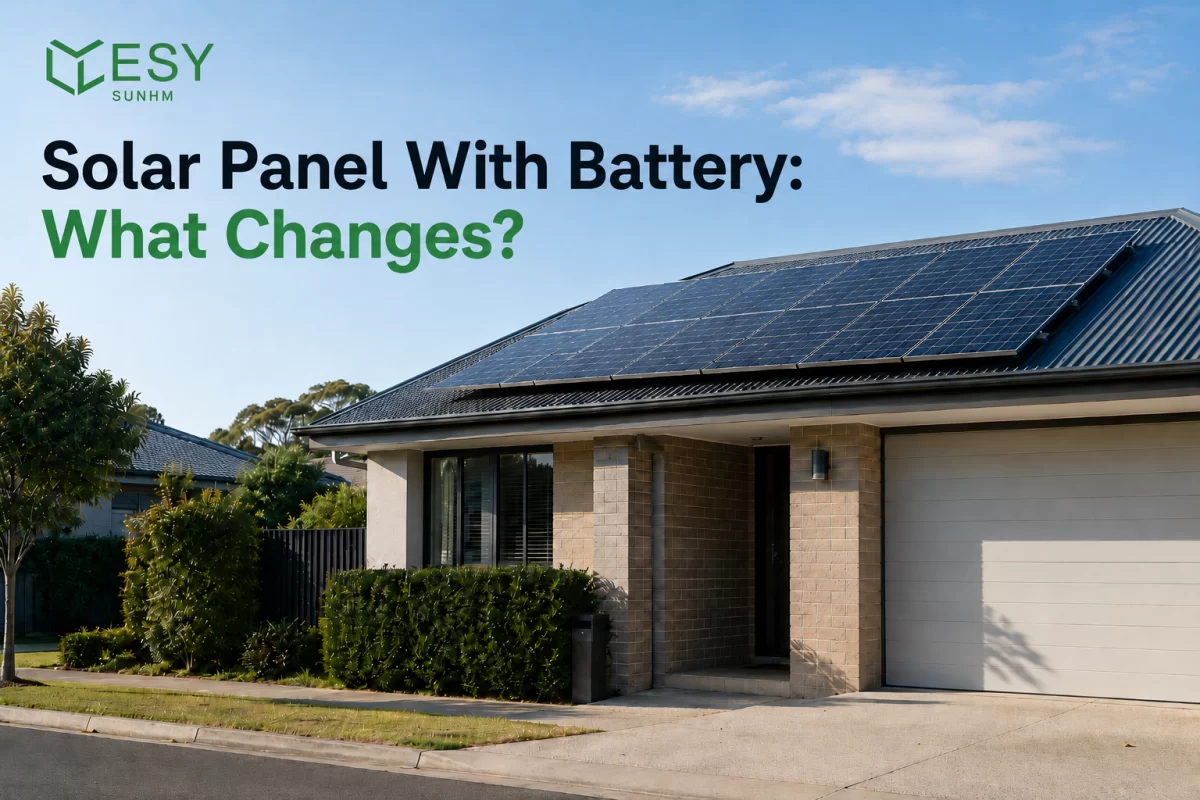
A solar-only system powers daytime loads first, exports surplus electricity to the grid, and relies on grid power after sunset. With a battery, more midday solar can stay on hold for evening use or outage backup.
- Solar panels without a battery. During the day, solar power is generated and consumed by the loads, while any surplus is exported to the grid at feed-in tariffs that are typically only a small fraction of retail tariffs. At night, expensive grid electricity is used to support the loads.
- Solar panels with a battery. During the daytime, solar is generated and consumed by loads; the rest is stored in the battery. At night, prioritize battery storage to support household loads; purchase electricity from the grid when there’s a shortage.
What Happens With Solar Panels Without Battery Storage?
Day-Time Solar Use
When battery storage is unavailable, daytime solar power must be used as it is generated. It supplies the home first, while any surplus is exported to the grid. Household appliances can run on solar electricity during sunny hours. After the home’s immediate electricity demand has been met, any excess power cannot be stored on site. The surplus is exported to the grid in accordance with the utility’s export rules.
That exported power is credited according to local grid rules, export limits, and the utility’s solar buyback or net metering policy. In many markets, the credit is way lower than the retail rate that the home pays for electricity later. The U.S. The Department of Energy’s homeowner’s guide to going solar explains why export credits vary by utility and location.
Night-Time and Blackout Limits
There are two primary limitations. First, at night, your home draws entirely from the grid because the panels are not producing and there is nowhere to store the day’s surplus. Second, a common but often overlooked limitation is that most standard grid-tied solar systems shut down during a blackout, even in daylight.
During a grid outage, grid-tied inverters automatically stop supplying power to the network to maintain safety. Their anti-islanding protection prevents backfeeding and helps protect line workers carrying out repairs. As a result, a conventional solar-only system offers no backup power.
What Changes When You Add a Home Battery?
More Solar Self-Consumption
A battery stores midday surplus power that would otherwise be exported at a low feed-in rate and releases it later during the evening peak or overnight. As a result, less evening demand has to be covered by grid electricity, especially during higher-cost after-dark hours. The DOE’s overview of solar energy and storage basics describes exactly this mismatch between when solar is produced and when it’s needed.
Backup Power Options
A battery can also keep essential circuits running during an outage. There are generally two tiers. Essential-load backup powers selected circuits such as lights, the fridge, internet, and a few outlets. Whole-home backup aims to run everything, but it requires more battery capacity and a more capable inverter.
Smarter Energy Control
A battery system usually adds app-based control that a basic solar array does not provide. Homeowners have real-time visibility into solar generation, household consumption, grid export, and even EV charging.
Some advanced systems also offer an AI energy management mode. Real-time or time-of-use electricity rates, expected solar generation, and household load patterns are used to forecast future energy needs. Based on these inputs, the system automatically determines when to charge or discharge the battery, retain energy for backup, or draw lower-cost electricity from the grid. Smarter scheduling can reduce electricity costs and increase the share of solar energy consumed within the home.
Cost, Payback, and System Design Trade-Offs
A solar-only system usually costs less upfront because it requires less hardware and involves a simpler installation process. Its payback can also be easier to estimate. A solar-plus-battery system costs more at the start, but it can increase solar self-consumption and add backup value during outages. The DOE’s solar-plus-storage primer offers a neutral overview of how these systems are configured and costed.
Battery payback depends on several factors, including battery price, usable capacity, retail electricity rates, feed-in rates, evening electricity use, and rebates. Battery storage offers greater financial value for homes with high retail electricity rates, low export credits, and substantial demand after sunset. By contrast, a solar-only system is often more economical when export credits are favorable or most electricity is consumed during daylight hours.
System design also influences the overall value of a battery project. A larger battery extends evening coverage and backup duration, but increases the system cost and sometimes requires a more capable inverter or backup configuration. Excess capacity remains underused when surplus solar is insufficient to charge the battery or evening demand is too low to discharge it. The better design choice is a battery size and backup configuration that match the home’s actual solar production, electricity use, and outage needs. A modest, well-matched system often delivers stronger value than an oversized battery that adds cost without much daily use.
When an All-in-One Solar Battery System Makes Sense
An all-in-one solar battery system suits homeowners who have decided to add storage and prefer a simpler installation process. It is especially useful for projects that need essential-load backup, app-based monitoring, outdoor installation, and a cleaner equipment layout.
A traditional solar-plus-battery setup may use a separate solar inverter, battery cabinet, gateway, backup box, and monitoring platform. The installation typically involves additional wiring, more extensive compatibility checks, and multiple points of contact for warranty support. An all-in-one energy storage system packages the hybrid inverter and battery into one pre-engineered unit, so the installer has fewer components to size, connect, and support.
The ESYsunhome HM Series is one example of this integrated approach. It combines a hybrid inverter with a modular battery system, with single-phase and three-phase options for different home sizes. The system also supports app-based energy monitoring, backup-ready operation for essential loads, and outdoor installation on IP66-rated models.
Conclusion
Solar-only systems provide a simpler, lower-cost option for homes where electricity use is concentrated during daylight hours, while consistently reducing daytime bills. A home battery adds no extra solar generation. Instead, it stores a greater share of solar energy for later use and supplies backup power during outages. Storage is particularly valuable for households with substantial evening demand or a clear need for outage protection. After deciding to add a battery, the remaining design choice lies between an all-in-one ESS and a system assembled from separate components.
To match a configuration to your own usage and backup needs, explore residential energy storage options for the home or ask an installer to quote both a solar-only and a solar-plus-battery setup side by side.
Frequently Asked Questions
Can solar panels work without battery storage?
Yes. Solar panels work well without a battery. They power your home directly during daylight and export any surplus to the grid. The only limitation is that you can’t store energy for use at night or during an outage.
What happens to excess solar power without a battery?
Any solar your home doesn’t use immediately is exported to the grid, subject to local rules and export limits. You’re usually credited at a feed-in tariff, which in most markets is way lower than the retail rate you pay to buy electricity back later.
Will solar panels power my home at night without a battery?
No. Without storage, panels produce nothing after dark, so your home draws entirely from the grid at night. A battery is what lets you use daytime solar during the evening and overnight.
Do solar panels work during a blackout without battery backup?
Generally no. Most grid-tied solar systems shut down during an outage to protect utility workers and the grid, even in daylight. Backup power requires a battery and a properly configured backup setup.
Can I add a home battery later to an existing solar panel system?
It depends. Some AC-coupled battery brands support existing solar systems, while replacing the current inverter with a hybrid model provides another option. Feasibility and cost depend on your current inverter, switchboard, available space, and the type of residential energy storage options you choose, so have an installer assess it.