









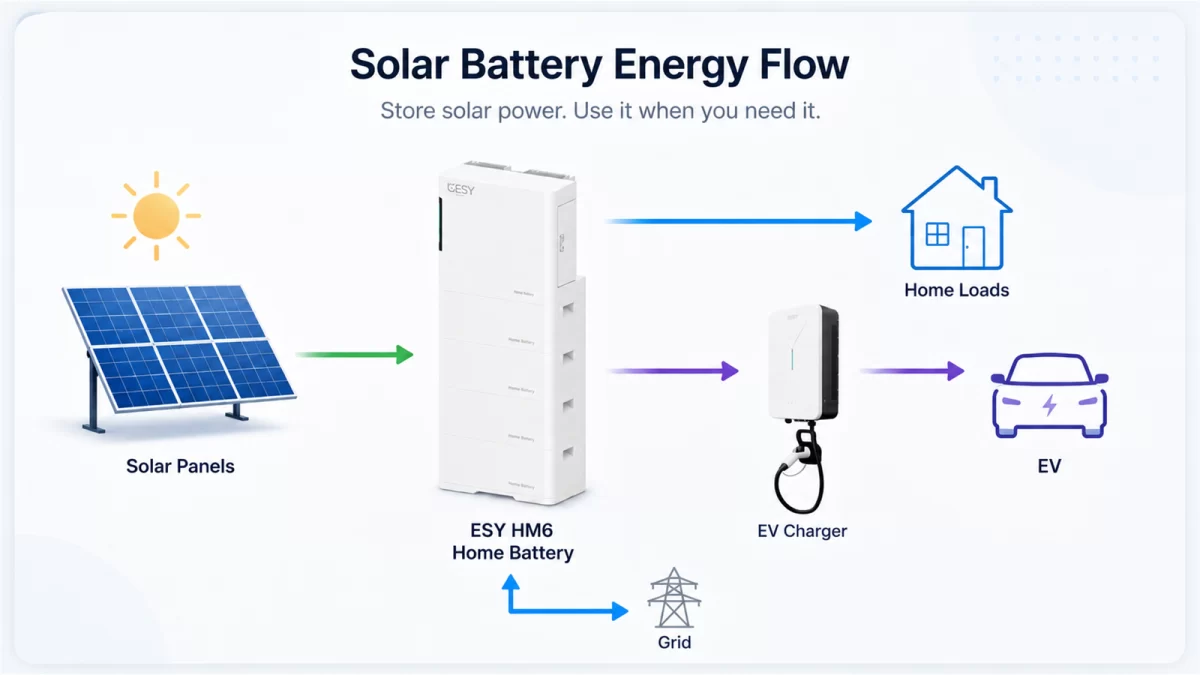
A solar battery stores the extra electricity your solar panels produce during the day and releases it later when your home needs power. It keeps surplus solar energy available for evening use, cloudy periods, outage backup, off-grid operation, or participation in a VPP program.
The process is automatic. Solar panels generate DC electricity, the home uses available solar power first, and any surplus charges the battery. When solar production can’t meet household demand, the system can discharge the battery or draw electricity from the utility grid. Meanwhile, the energy management system decides when to charge, discharge, hold reserve power, or export electricity. For homeowners, this means solar energy generated remains available when it matters most.
Typical use cases
Homeowners often install solar panels to reduce their reliance on the grid or to enhance backup power. Here are three common scenarios.
Solar self-consumption for household loads and EV charging
A battery helps you use more of the solar power your roof already produces. Panels usually peak around midday, when many homes are using less electricity. Without storage, that extra power is sent to the grid for a relatively small credit. Later in the evening, when people are home and demand rises, the household buys power back at the retail rate. A battery keeps more of that midday surplus at home for later use.
In daily use, the system gives solar power to the house first and sends any extra into the battery. Appliances that run during daylight hours can use solar directly, such as a dishwasher, washing machine, or a pool pump. After sunset, the battery can cover evening loads like lighting, cooking, refrigeration, and air conditioning. The energy management system handles these switches automatically as household demand changes.
EV charging can be connected to the same solar battery system. When solar production is high, the system can send power directly to the charger. When the car is plugged in later, stored solar energy can help support charging, depending on the battery size and charging schedule. This helps homeowners use more of their own solar power for daily driving and can reduce charging costs over time.
Backup during outages
During an outage, a solar battery can keep selected parts of your home running with power stored earlier. Standard grid-tied solar panels usually shut down when the grid fails for safety, so backup power needs a battery, a backup-capable inverter, and a transfer switch that separates the home from the grid. For homes with essential backup loads, a single-phase all-in-one ESS brings those core parts into one system.
When an outage happens, the system detects the grid failure, disconnects the home from the grid, and starts powering the backup circuits. These usually include essentials such as lighting, the refrigerator, the router, and medical equipment. The switch happens quickly, often with little more than a brief flicker.
Solar helps extend the backup time. During the day, the panels can keep producing power for the isolated home and recharge the battery. At night, the battery supplies the selected loads. How long the home stays powered depends on battery capacity, weather, and how many devices are running, so keeping backup loads limited makes the stored energy last longer.
Off-grid operation for families without stable grid supply (can pair with diesel generator)
For homes without a stable grid connection, the system setup has to be sized more carefully than a standard backup system. The battery must cover the hours or days when solar production is low, and the solar array must be large enough to power the home while also recharging the battery. For many off-grid homes, the goal is to keep essential daily loads running without relying on the grid.
A diesel generator can be added as an additional backup source when several cloudy days reduce solar output. In that case, it supplies household loads and recharges the battery at the same time. The solar battery system must support generator input, coordinated charging and discharging, and automatic generator start through the inverter or a compatible controller.
Participation in a VPP Program
A virtual power plant, or VPP, connects many home batteries through a digital platform so they can operate together as a shared energy resource. When electricity demand is high or the grid needs additional support, the VPP operator may temporarily discharge part of the battery’s stored energy or adjust its charging schedule.
Homeowners can usually set a minimum backup reserve so enough power remains available for household use or outages. In return, participants may receive bill credits, fixed payments, energy-market revenue, or other incentives. The actual benefits depend on the electricity retailer, VPP provider, local market rules, battery compatibility, and how often the battery is called upon to support the grid.
Smart features
Smart features help the battery make better charging and discharging decisions. They show how the system is running, adjust to your energy use, and help you get more value from the power you store.
Real-time monitoring
Most households have no idea where their solar actually goes. The bill arrives lower than before but not as low as promised, and nothing on the roof or the wall explains why. That is because something is drawing power overnight, the battery never fills, or half the surplus is still going to the grid at the export rate. None of it is visible if without data.
Real-time monitoring turns that guesswork into a picture you can read in seconds. The ESYsunhome App shows the live energy flow across the system, so the direction of every watt is clear, whether it comes from the panels, the grid, or the battery. Alongside it sits the real-time power of the PV array, the household load, the grid connection, and the battery, plus consumption, self-consumption ratio, export proportion, and savings measured against the electricity prices set for the day.
That visibility pays for itself. Seeing consumption laid against generation is what prompts a family to move the dishwasher or the pool pump into the middle of the day, lifting solar self-consumption at no cost.
AI mode
Manual schedules work for a while, but they rarely stay accurate for long. Seasons change, electricity tariffs shift, and household routines move around. This is exactly the kind of problem ESYsunhome’s AI mode is designed to handle. It predicts PV generation, household consumption, and dynamic electricity prices, then adjusts charging and discharging automatically so the battery stores power at the right time and uses it when grid electricity is more expensive.
In real home systems, this kind of control often makes the difference between a battery that simply works and one that quietly saves more in the background. Homeowners get better use of stored solar, less reliance on peak-rate grid power, and fewer settings to manage. AI mode brings the most value when your electricity plan has time-based pricing, while flat-rate users still benefit from smoother self-consumption. Explore ESYsunhome residential energy storage solutions to find a system that fits your household, or review the U.S. Department of Energy’s homeowner’s guide to going solar before planning your setup.
FAQ
What does a solar battery do?
A solar battery stores surplus electricity generated by your solar panels and makes it available later. The stored energy can support evening household use, EV charging, outage backup, off-grid operation, or participation in a virtual power plant program.
Can I add a battery to an existing solar system?
Yes, in many cases. An installer needs to check your inverter, electrical panel, available space, and whether you want backup power or only storage for daily solar use.
How long can a solar battery power a house?
It depends on battery size and the loads you run. Essential loads may run for several hours or overnight, while air conditioning, pumps, ovens, and EV charging drain the battery much faster.
Can a solar battery charge an electric vehicle?
Yes. An EV charger can be integrated with the solar and battery system. The vehicle may charge directly from surplus solar during the day or partly from stored energy later, depending on battery capacity, charger power, household demand, and the charging schedule.
What is a VPP, and how can a home battery participate?
A virtual power plant, or VPP, coordinates many connected batteries to support the electricity grid. With the homeowner’s permission, a VPP operator may charge or discharge part of the battery during selected periods. Participants may receive financial rewards, but availability, payments, battery reserve settings, and operating rules vary by provider and region.