









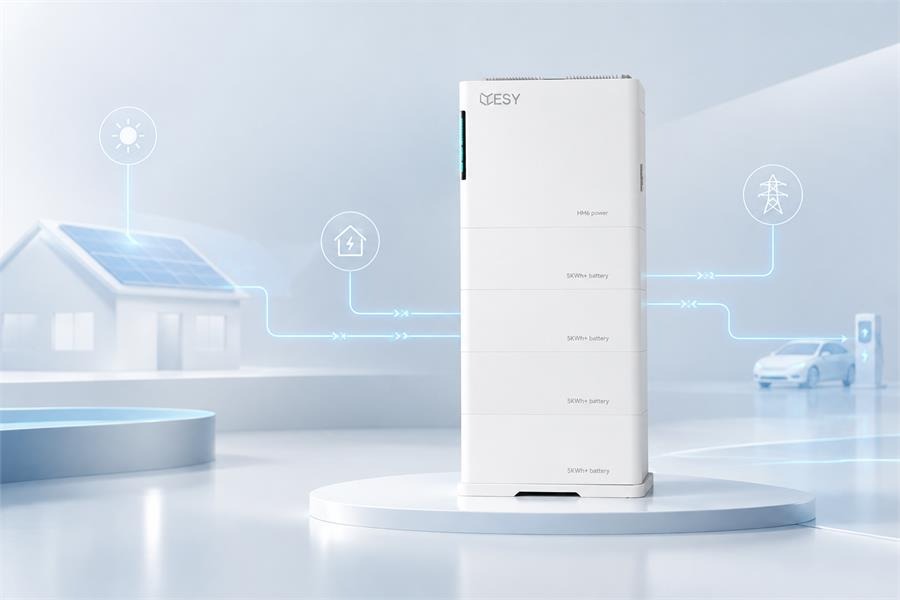
At ESYsunhome, we design home energy management around a practical question: when solar power, battery system and EV are connected, where should the next kilowatt-hour go? Our AI-enabled approach brings tariff signals, forecasts of PV generation and battery state of charge, household consumption patterns, and EV schedules into one operating plan. The controller can then adjust that plan as prices, weather and household needs change.
In practice, an AI home energy management system helps a household decide when to use solar power, when to charge the battery, when to charge the EV and when to draw from or export to the grid. This matters because time-of-use and dynamic tariffs reward flexible energy use, but the most affordable decision is not always the same every day.
Why Time-of-Use and Dynamic Tariffs Need an Integrated Home Energy System
Time-of-use and dynamic tariffs create earning opportunities when the home can respond to changing electricity prices. A time-of-use tariff normally divides the day into predefined periods, such as off-peak, shoulder and peak hours. A dynamic tariff may change more frequently according to market conditions.
Our view is that tariff awareness becomes genuinely useful when it is connected to the rest of the home. Charging an EV during a cheap period may look like the right decision, but it could leave the battery without enough energy for evening demand.
An integrated energy management platform evaluates several signals together:
- Electricity prices
- Solar generation and weather conditions
- Household consumption patterns
- Battery state of charge
- EV charging requirements
- Backup reserve settings
A fixed timer cannot make this distinction. It follows the same schedule whether tomorrow is sunny or cloudy, whether the EV needs a full charge or only a small top-up, and whether the battery is being reserved for backup. An adaptive energy management system revises the schedule when its inputs change.
How AI Uses Dynamic Tariffs to Control Battery Charging
Charge during low-price periods
The battery can charge from the grid when electricity is inexpensive and a later period is expected to be more expensive. However, the controller should first check whether the battery has enough reserved capacity and whether strong solar generation is expected later. If a sunny day is forecast, leaving room for solar may create greater value than charging the battery to full overnight. We recommend treating low-price charging as a controlled option rather than an automatic rule.
Discharge during peak-price periods
During expensive tariff periods, the battery can supply household loads and reduce electricity imported from the grid. This is often relevant in the early evening, when cooking, heating, cooling and appliance use may rise at the same time.
Discharge decisions should still respect battery limits and backup requirements. If a home has a high evening load or frequent outages, using every available kilowatt-hour for tariff savings may be the wrong choice. A defined minimum state of charge gives the system a clear boundary: energy below that level remains available for backup or unexpected demand.
The practical comparison is therefore not simply “cheap price versus expensive price”. It is the expected peak-grid cost compared with the effective cost of using stored energy after conversion losses and the homeowner’s allowance for battery cycling. This calculation helps prevent short-term savings from being prioritised over long-term resilience.
How AI Coordinates EV Charging with the Home Battery
Prioritise solar charging when available
When solar production exceeds the home’s immediate demand, directing the surplus to the EV helps homeowners use more of their own renewable energy and rely less on grid electricity. This is especially valuable during daytime charging, when exporting unused solar may provide less value than using it to reduce transport costs. Solar-first charging can also reduce unnecessary demand on the home battery, helping preserve stored energy for evening loads and backup needs.
Our EV22 V2E bidirectional EV DC charger is designed to integrate with compatible ESYsunhome’s three-phase energy storage systems. It supports Vehicle-to-Home and Vehicle-to-Grid applications, delivers up to 22 kW of DC power and includes a Green Charging Mode that prioritises solar energy. By creating a direct route from available solar generation to the vehicle, the charger helps reduce avoidable battery cycling while giving homeowners a more efficient way to manage solar power and EV charging.
Shift EV charging to off-peak hours
Solar power is not always available when the vehicle is parked. For overnight charging, the controller can delay or reduce charging until a lower-cost tariff window while still meeting the required departure time.
Consider a household with rooftop solar, a 20 kWh battery and an EV that must be ready by 7:30 a.m. If the overnight tariff is low but strong solar generation is forecast for the following day, the system may charge only part of the battery overnight, preserve capacity for daytime solar and schedule the EV around its departure requirement. If the next day is expected to be cloudy, it may choose a larger overnight charge.
Adaptive by Design: Rolling Updates Based on Real Data
Crucially, the AI strategy is never static. The system operates on a rolling update cycle, recalibrating its energy plan every 3 to 4 hours based on real-time data. By continuously comparing actual solar generation, live grid prices, and immediate household consumption against earlier forecasts, the AI can instantly adapt to unexpected changes. This ensures that your home’s energy routing is always optimized for the immediate future, rather than relying on outdated assumptions from the night before.
Conclusion: Smarter Home Energy Starts with Tariff-Aware AI Control
AI home energy management brings tariffs, solar generation, battery storage and EV charging into one coordinated decision process. It can shift flexible demand to lower-cost periods, prioritise available solar, reduce expensive grid imports and protect a defined backup reserve.
Our planning principle is to start with the control strategy, not battery capacity alone. The most suitable solution depends on the household’s energy priorities, EV schedule, solar forecast, tariff rules, electrical infrastructure and compatibility between the charger, inverter, battery and vehicle.
When these conditions are evaluated together, homeowners gain more than an automated charging schedule. They gain a clearer way to manage energy costs, renewable energy and backup expectations through one connected platform. Explore our residential energy storage solutions and confirm model-specific settings through the latest manuals and datasheets before making a final system decision.
FAQ
Is a dynamic tariff worthwhile if I already have solar and a home battery?
Yes, if your system is smart enough to manage it. A dynamic tariff is only beneficial when the price difference justifies the extra battery cycling. An AI energy management system can do this math for you.
Will chasing cheap electricity drain my home’s backup power?
Not with an AI-driven system. While a basic timer might blindly drain your battery to capture low rates, our system always respects your pre-defined “minimum state of charge.” It protects your emergency backup reserve, only using excess capacity for tariff savings.
What happens if the weather forecast changes?
The system adapts continuously. Unlike a fixed timer, our AI compares forecasts with real-time data, updating its energy strategy every 3 to 4 hours.