









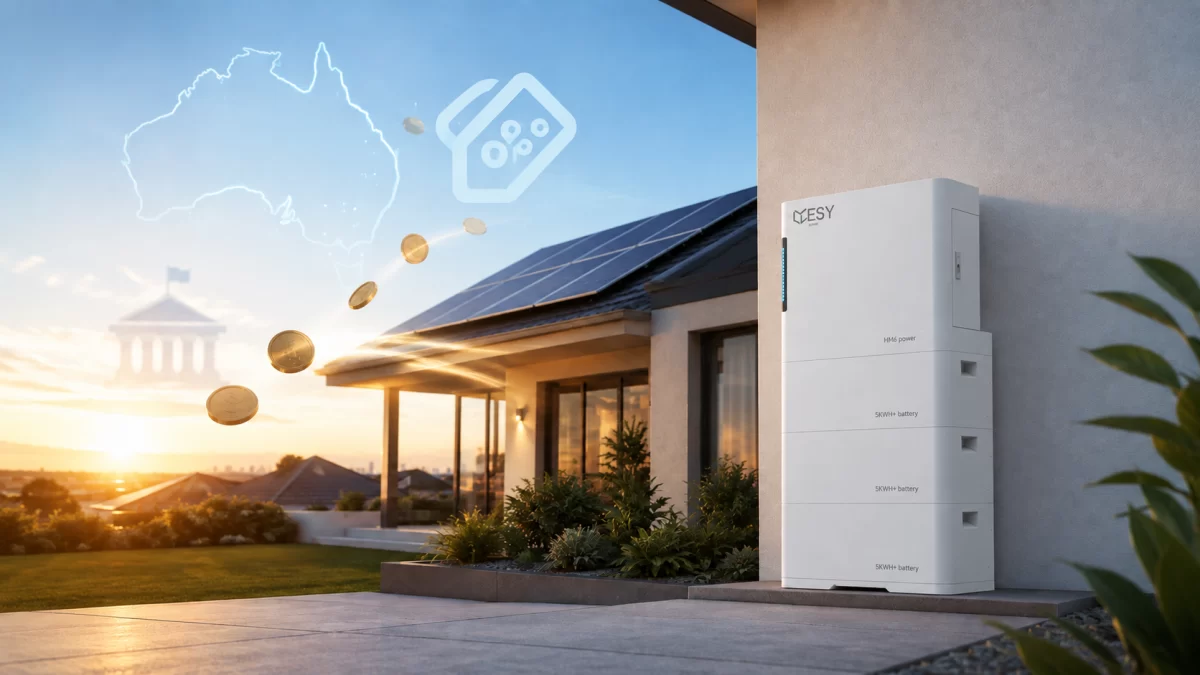
Australia’s 2026 home battery rebate is worth about $252 per usable kWh under the federal Cheaper Home Batteries Program. With some state and territory support added, battery payback can fall from roughly 7 to 12 years to about 6 to 9 years, depending on location, evening usage and electricity tariffs.
The logic is simple: the rebate cuts the upfront battery cost by close to 30%, while annual bill savings remain largely unchanged. In 2026, the key change is size-based tiering, which makes accurate battery sizing one of the biggest drivers of payback.
What's the Home Battery Rebate Australia 2026?
It is two separate programs stacking on the same installation. The federal Cheaper Home Batteries Program applies nationwide and arrives as an upfront discount on the quote. State and territory schemes sit on top, vary widely in value, and several have already closed.
Rebate structure: country-level rebate and state-level rebate
The federal layer is administered through the Small-scale Renewable Energy Scheme. Installing an eligible small-scale renewable energy system, such as solar PV or solar battery, allows you to create Small-scale Technology Certificates (STCs). Each STC represents 1 megawatt-hour (MWh) of renewable electricity generated, stored, or displaced by the system.
Households can create and sell the STCs themselves, either through the STC Clearing House or on the open market. Alternatively, you can assign the right to create them to a registered agent, who may provide an upfront discount on the system’s purchase price.
The state layer works differently in each jurisdiction. Some pay a cash incentive for joining a Virtual Power Plant, and some offer only a low-interest loan. Values range from nothing at all to around $3,800, and these schemes change more often than the federal program does.
Cheaper home battery program explained
The federal scheme opened on 1 July 2025 and now delivers a discount of around 30% on the upfront cost of installing a battery. Eligible systems fall between 5 kWh and 100 kWh, and certificates can be created on the first 50 kWh capacity.
Uptake ran well ahead of forecast. In December 2025 the government lifted the program’s estimated funding from $2.3 billion to about $7.2 billion over four years, and two adjustments followed on 1 May 2026.
The first lowered the STC factor from 8.4 to 6.8 certificates per usable kWh. At the Clean Energy Regulator’s fixed Clearing House price of $40 per certificate, 6.8 STCs works out to $272 per usable kWh in theory. Certificates are usually traded on the open market at a small discount, and installers deduct administration and trading costs, which is why quotes through 2026 have commonly reflected something closer to $252 per usable kWh. The figure on any given quote will sit somewhere in that band.
The second adjustment introduced tiering by capacity.
| Usable capacity band | Share of the STC factor applied | Practical effect |
|---|---|---|
| 0 to 14 kWh | 100% | Full rebate value on the portion most homes actually cycle |
| Above 14 kWh to 28 kWh | 60% | Extra capacity still earns support at a reduced rate |
| Above 28 kWh to 50 kWh | 15% | Marginal support becomes small against hardware cost |
The tiering is progressive, so the first portion of capacity keeps the higher rate and only capacity above each threshold drops down. The factor is scheduled to step down every six months through to 2030, and the applicable rate is set by the date the certificate of electrical compliance is signed.
These bands deserve a clear caveat. They are funding settings written into the Renewable Energy (Electricity) Regulations 2001 and describe how public money is allocated in this specific program. They are not a technical ceiling on battery size, a safety standard, or guidance on what any particular home should install. Detail on qualifying systems sits on the program’s eligibility page, and the certificate count for a given system is worth confirming with the installer before signing.
State-level rebates explained
Support varies sharply by postcode, and the map has thinned since the federal program arrived.
- Western Australia runs the strongest offer. The WA Residential Battery Scheme pays Synergy customers up to $1,300 and Horizon Power customers up to $3,800, calculated on the first 10 kWh of usable capacity. Zero-interest loans form part of the scheme.
- New South Wales has shifted its support toward grid participation through the Virtual Power Plant incentive, which stacks with the federal discount. From 1 July 2026, batteries between 2 kWh and 50 kWh qualify, with the payment calculated on usable capacity up to 28 kWh. The amount varies by VPP provider and contract terms, so comparing several offers is worthwhile.
- South Australia closed its Home Battery Scheme. Battery-related support may still be available through Retailer Energy Productivity Scheme VPP activities, subject to provider eligibility and current offer availability.
- ACT has no hardware rebate. Under the Sustainable Household Scheme, new applicants from 1 July 2026 can borrow up to $20,000 at 3% interest, with battery storage among the eligible products. Households approved before that date remain on the earlier $15,000 limit.
- Victoria, Queensland, Tasmania and the Northern Territory have closed their state battery subsidies and loan programs, covering Solar Homes, Battery Booster, the Energy Saver Loan Scheme and the Home and Business Battery Scheme. The federal rebate still applies in full.
How Does it Work?
Payback period before the rebate
Without any rebate, adding a battery to an existing solar system has generally sat in the 7 to 12 year range. The arithmetic is unforgiving. The full hardware and installation cost lands upfront, while the annual return comes from a modest pool made up of avoided evening grid purchases plus energy that would otherwise have been exported at a low feed-in rate.
That range also assumed reasonably strong self-consumption. Homes emptying only part of the battery each night sat at the longer end, which is where oversizing has always done quiet damage to the numbers.
Payback period after the rebate
The figures below come from Solar Calculator’s 2026 modelling, which assumes a 6.6 kW solar system paired with a 10 kWh battery, average household consumption of 15.3 kWh per day, and the federal rebate applied.
| State or territory | Indicative payback on a new solar and battery system |
|---|---|
| South Australia | Around 5.8 years |
| New South Wales | Around 6.7 years |
| Queensland and Western Australia | Around 7.0 years |
| ACT | Around 7.6 years |
| Victoria | Around 8.6 years |
| Northern Territory | Around 9.3 years |
| Tasmania | Around 9.6 years |
Households with heavier evening loads, an electric vehicle or a time-of-use plan carrying a steep peak rate will land shorter than these figures. Low-consumption homes will land longer, and no rebate changes that.
Why Sizing Now Drives the Payback Number
The May 2026 tiering makes battery size more important. Capacity up to 14 kWh receives the full federal support rate, but capacity above 14 kWh receives less, and capacity above 28 kWh receives only a small share. That means extra storage only improves payback if the household actually cycles it often.
For most homes, the stronger result comes from sizing the battery around real evening and overnight demand, then leaving room to expand later. Our home battery sizing guide for 2026 explains that calculation in more detail.
Modular systems help because households can start near the full-rate rebate band and add capacity later for an EV, heat pump or higher overnight load. Our residential all-in-one ESS range follows this approach, including the single-phase HM6 system, which starts from 5.12 kWh and scales by module. For larger homes, see our single-phase versus three-phase ESS comparison.
VPP participation can also change the payback calculation where incentives are available, though it usually means giving the operator some control over battery dispatch. We explain that trade-off in our guide to VPP-compatible home batteries.
FAQs
How much is the home battery rebate in Australia in 2026?
Between roughly $252 and $272 per usable kWh for the first 14 kWh, based on 6.8 STCs per kWh. The top of that range reflects the $40 Clearing House price, and quotes land lower after trading and administration costs. Capacity from 14 to 28 kWh earns 60% of the rate, and 28 to 50 kWh earns 15%.
Can federal and state rebates be claimed together?
In most cases yes. The WA Residential Battery Scheme and the NSW VPP incentive both stack on the federal discount. Rules change often, so confirm with the relevant state body before committing.
Does the rebate apply when adding a battery to existing solar?
Yes. Existing rooftop solar satisfies the requirement. A hybrid inverter may be needed if the current system is not battery ready, and that cost falls outside the rebate.
Will waiting make the rebate better?
No. The STC factor declines every six months to 2030. Falling hardware prices offset part of that, so the real question is how many evenings of full retail tariffs the household pays while waiting.
Where This Leaves a 2026 Battery Decision
The home battery rebate Australia 2026 provides has moved storage into workable territory for most grid-connected households, with a structure that now rewards accurate sizing over maximum capacity. The number that decides everything is the household’s own evening consumption, because it sets both the annual saving and whether capacity above 14 kWh will ever earn back its reduced rebate. Figures here come from the sources listed below and are general information about how the schemes operate, not financial advice. An accredited installer can model the certificate value against a real quote and a real electricity plan, and our distributor and service outlet directory lists partners across Australia who can run those numbers.
Sources
- Department of Climate Change, Energy, the Environment and Water: Cheaper Home Batteries Program
- Clean Energy Regulator: Batteries
- Department of Climate Change, Energy, the Environment and Water: Small-scale technology certificates
- Department of Climate Change, Energy, the Environment and Water: Eligibility information for the Cheaper Home Batteries Program
- Government of Western Australia: WA Residential Battery Scheme
- NSW Climate and Energy Action: Virtual power plant (VPP) incentive
- Government of South Australia Department for Energy and Mining: Home Battery Scheme closed
- ACT Government Climate Choices: Sustainable Household Scheme
- Solar Victoria: Solar Homes Program
- Queensland Government: Battery Booster Program
- Renewables, Climate and Future Industries Tasmania: Energy Saver Loan Scheme
- Northern Territory Government: Home and Business Battery Scheme
- Solar Calculator: Solar Battery Prices & Cost Guide Australia 2026
Australia home battery resources
Rebate value depends on the installed system, usable capacity, backup requirements and local installer planning. These resources help narrow the product and support path.