









Commercial and industrial battery storage is a battery energy system used by businesses to lower peak demand costs, store solar energy, and supply backup power during outages. It charges when grid power is cheap or solar generation is high, then discharges during peak-price periods, demand spikes, or power interruptions.
Most commercial buyers come to battery storage for two reasons: bills are climbing, and outages are getting longer. According to the Association of German Chambers of Commerce and Industry, nearly 25% of industrial businesses reported short outages, and 11% experienced longer power cuts. Even brief interruptions can be costly, often causing losses of €10,000 to €50,000, and sometimes more than €100,000, especially when production processes are disrupted.
What Is BESS?
A BESS, or battery energy storage system, stores electricity from the grid or solar panels and releases it when needed. For commercial and industrial sites, BESS is used to reduce peak demand charges, improve solar self-consumption, and provide backup power. Most commercial BESS today use lithium iron phosphate (LFP) batteries because they are cost-effective, stable, and widely used in stationary energy storage. BloombergNEF reports LFP has become the dominant choice for stationary storage, partly because it is now the lowest-priced battery segment.
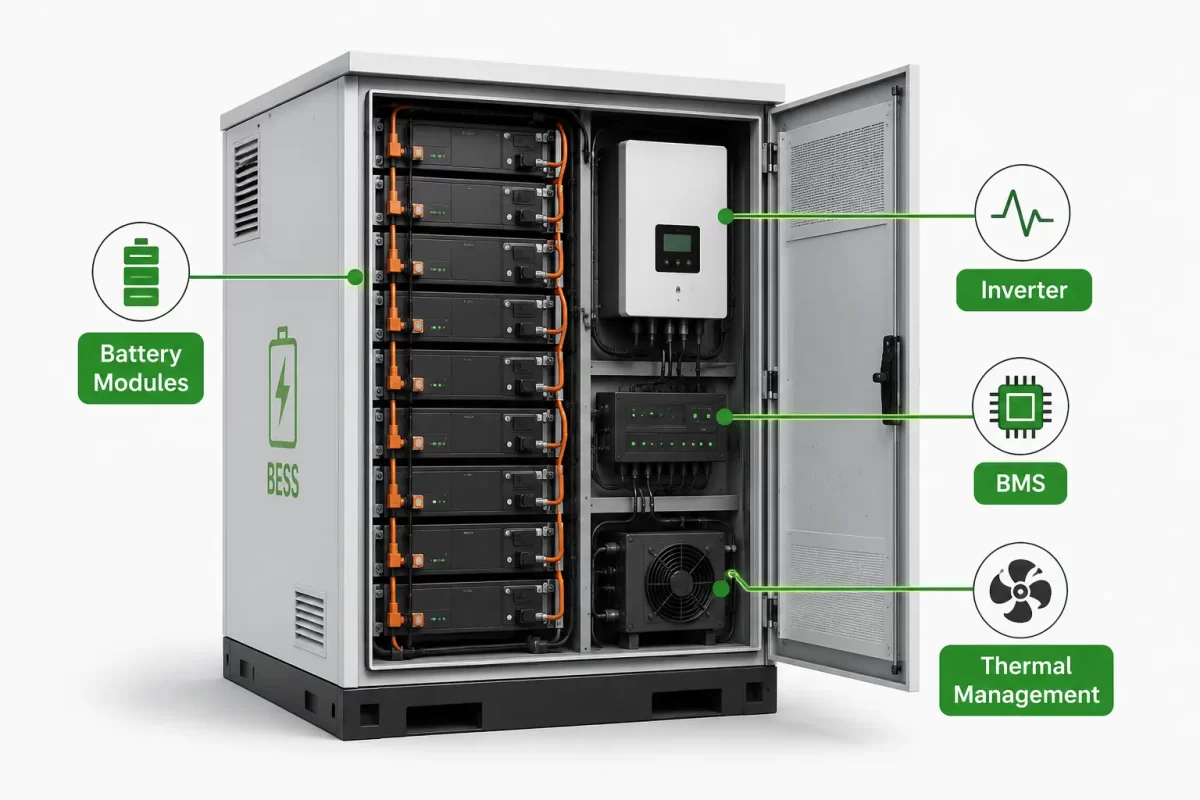
How Does a BESS Work?
A BESS charges when electricity is cheap or solar generation is high, then discharges during peak-price hours, demand spikes, or outages. Its control software manages charging and discharging.
5 Main Components
| Component | Function |
|---|---|
| Battery modules | Store energy, usually using LFP cells. |
| PCS / inverter | Converts DC power to AC power and controls charge/discharge. |
| BMS | Monitors cells and protects against overheating, overcharging, and faults. |
| EMS | Brain of a BESS, in charge of overall energy management and scheduling. |
| Thermal and safety system | Controls temperature and supports fire protection. |
Why Businesses Use It
Businesses install battery storage mainly to reduce demand charges, keep operations running during outages, and get more value from solar. Demand charges are based on your single highest power spike in a billing period, not total electricity use, and they can dominate a C&I bill. Research from the National Laboratory of the Rockies (formerly NREL) puts them at roughly 30 to 70 percent of a commercial and industrial customer’s bill.
Two applications carry most of the financial case:
- Peak shaving and valley filling: the system discharges during demand spikes to lower the metered peak (peak shaving), and charges during cheap off-peak hours or high-solar midday hours so the stored energy is ready for the next spike (valley filling). The pair flattens your load curve and cuts both demand and energy charges.
- Uninterruptible power supply (UPS) for business continuity: when the grid fails, the system switches over and keeps critical loads such as production lines, refrigeration, servers, and safety systems running. This protects the revenue, spoiled inventory, and restart costs that an outage would otherwise destroy.
| Use Case | What It Does |
|---|---|
| Peak shaving | Discharges during demand spikes to lower peak charges |
| Valley filling | Charges during off-peak or high-solar hours, ready to discharge later |
| UPS / backup power | Keeps critical loads running through outages |
| Solar self-consumption | Stores midday solar for evening use |
For sites with sharp, predictable peaks, peak shaving and valley filling is often the fastest financial win. For sites where downtime is expensive, the UPS function alone can justify the project. Start by checking interval meter data, because demand-charge exposure and outage sensitivity together decide whether storage pays off.
Air Cooling vs Liquid Cooling: Which Should You Choose?
Choose based on power density, climate, and how hard the system will cycle. Both keep cells in a safe temperature range, but they suit different projects.
Air cooling uses fans to move air across the modules. It is simpler, cheaper, and easier to maintain, but its heat-transfer capacity is limited for high-power or high-density systems, according to peer-reviewed research in RSC Advances.
Liquid cooling circulates fluid through cold plates and holds temperatures more uniform. A controlled study in Journal of Energy Storage (ScienceDirect) found liquid cooling delivers more even temperatures across the pack, which supports longer life and tighter control. The trade-off is higher upfront cost and more maintenance.
Need Help Sizing a System for Commercial Projects?
If you have worked through the sizing and cooling sections above, the next step is matching those numbers to hardware and a supplier who can support the project long term. That is where ESYsunhome’s modular commercial energy storage range fits, with two configurations that map directly to the two main reasons businesses install storage in the first place.
| If your priority is… | Suggested configuration | Key capability |
|---|---|---|
| Cutting demand charges, stable grid | ES125-261 ESS (standard) | Grid-tied peak shaving and valley filling |
| Business continuity, mixed energy sources | ES130-261 hybrid system (premium) | UPS plus PV + storage + diesel integration |
To pair a configuration with your load profile, the C&I energy storage solution overview is a useful starting point.
FAQs
References
- BloombergNEF, Lithium-Ion Battery Pack Prices Fall to $108 Per Kilowatt-Hour (about.bnef.com)
- National Laboratory of the Rockies (formerly NREL), Commercial Battery Storage, 2024 Annual Technology Baseline (atb.nrel.gov)
- U.S. Department of Energy, Energy Department Renames NREL “National Laboratory of the Rockies” (energy.gov)
- Lawrence Berkeley National Laboratory, Berkeley Lab Estimates Sustained Electric Power Interruptions Cost the U.S. Approximately $44 Billion Annually (emp.lbl.gov)
- McKinsey & Company, Why the Future of Commercial Battery Storage Is Bright (mckinsey.com)
- RSC Advances, Thermal Management of Lithium-Ion Battery Energy Storage (pubs.rsc.org)
- Journal of Energy Storage / ScienceDirect, Comparative Study on Thermal Management for Energy Storage Lithium Battery (sciencedirect.com)
ESY SUNHOME is an advanced energy solutions provider serving residential and commercial clean energy applications, with localized 24/7 support and UNGM-authorized supplier status. Its products carry multiple international certifications, including TUV, CE, IEC 62109, IEC 62619, and EMC, along with regional grid-connection standards such as Australia’s AS4777.2 and Germany’s VDE-AR-N 4105.