









A dynamic tariff battery is a storage system that charges when wholesale electricity prices are low and discharges when they peak. Across Europe and Australia the model has moved from niche to mainstream, with EU Directive 2019/944 requiring dynamic price contracts as a baseline since 2021 and Australia’s Cheaper Home Batteries Program now tying battery rebates to VPP-ready hardware. The case study at the heart of this guide shows what that environment looks like in a real home.
Comparing Electricity Tariff Models
Electricity plans vary by how often the price changes and how far ahead you know it. Those two factors decide what a battery can do with the price signal. A flat rate move never. A time-of-use plan moves between fixed bands. A dynamic tariff moves with the wholesale market each hour or half hour.
| Tariff type | How is the price set | Battery upside |
| Flat rate | One fixed rate | Mainly Self-consumption |
| Time-of-use | Peak, off-peak, shoulder periods | Moderate, predictable |
| Dynamic tariff | Near real-time | Highest needs automation |
A time-of-use plan can often be managed with scheduled charging and discharging because the price bands are known in advance. A battery energy storage system on a dynamic tariff benefits more from automated control, because software can read day-ahead price and, where available, intraday price to place charging in the lowest-cost periods and discharge during higher-price periods.
AI Optimized BESS Control for Dynamic Tariffs
An AI-optimized battery system is a storage system whose charge and discharge are scheduled by software that reads the day-ahead electricity price, not by a fixed timer or daily user input. It blends forecasts of electricity price, solar output, and household load to place every cycle where it matters the most.
Manual price-watching does not scale, since most owners stop checking prices within months. Automation removes that fade, and it is what brings dynamic-tariff savings into reach without daily attention. ESYsunhome’s AI tariff optimization battery app delivers that control at the household level, with smart energy management software handling the price, weather, and load signals in the background, and a cloud-based monitoring platform for operators running many sites at once.
ESY Success Story, Dynamic Tariff Battery in a Dutch Home
A residential customer in the Netherlands runs a 30 kWh HM20-30 three-phase system. Monthly use is about 3,200 kWh, with onsite renewables covering 2,272 kWh and the remaining 928 kWh drawn from the grid.
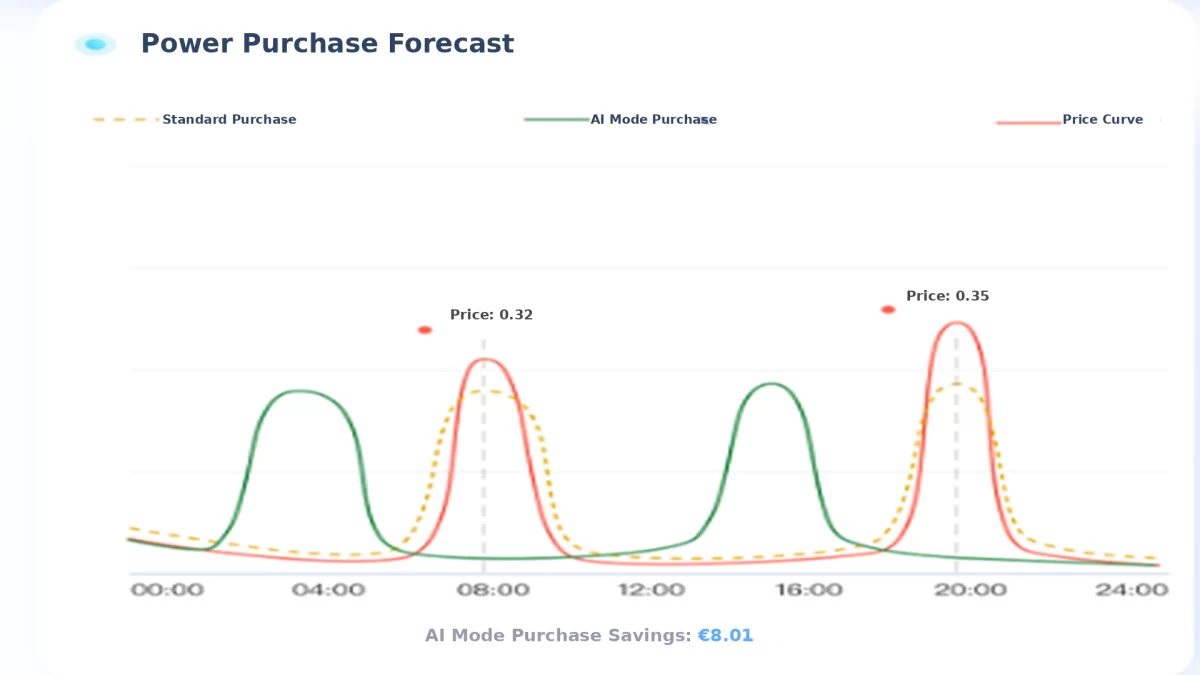
Before AI control, most of that grid energy was bought during peak tariff periods, typically between 7-9 a.m. in the morning and 6-9 p.m. in the evening, when prices ran around 0.30 to 0.35 euros per kWh. The battery had storage but no day-ahead price forecasting to time its charging, so monthly grid spend sat near 324.80 euros.
After AI Mode was activated, the controller forecasted dynamic tariff prices, shifted charging to low-price midday and overnight windows, and discharged into the evening peak. Estimated monthly grid spend fell to about 124.80 euros.
| Item | Before AI control | After AI control |
| Grid energy required | 928 kWh | 928 kWh |
| Main buying window | 7 to 10 p.m. peak | Low-price midday and overnight |
| Average peak price | 0.30 to 0.35 €/kWh | Avoided where possible |
| Monthly grid spend | ~€324.80 | ~€124.80 |
| Estimated savings | – | ~€200 (62%) |
The hardware was identical in both periods. What changed was the addition of forecasting that read the dynamic tariff and decided when to act, which dropped the monthly grid bill by an estimated 62 percent. Annualized at the same pattern, that is roughly 2,400 euros per year the household keeps, with no additional solar capacity and no new equipment.
VPP Compatible Home Batteries as the Future Format
A virtual power plant (VPP) is a network of distributed battery systems coordinated by software so a utility or aggregator can dispatch them together as if they were one larger plant. Each household keeps using its own battery, but during peak demand or grid stress, the operator can charge or discharge across the fleet at once. Owners are paid for that flexibility, usually as a sign-up credit, per-event payments, or a higher feed-in rate.
Market infrastructure has caught up. EPEX SPOT’s switch to 15-minute day-ahead intervals tightened the price signal and gave batteries finer arbitrage windows. In Australia, AEMO is rolling out dynamic operating envelopes and a national CER Data Exchange so distribution networks can coordinate household exports rather than capping them flat.
FAQ
Summary
A dynamic tariff battery turns a passive store into a daily trading asset, and most of that value depends on the tariff plan and the control software rather than the hardware itself. Real residential data from the Netherlands show estimated monthly savings of 200 euros once AI control matches charging windows to forecast prices.