









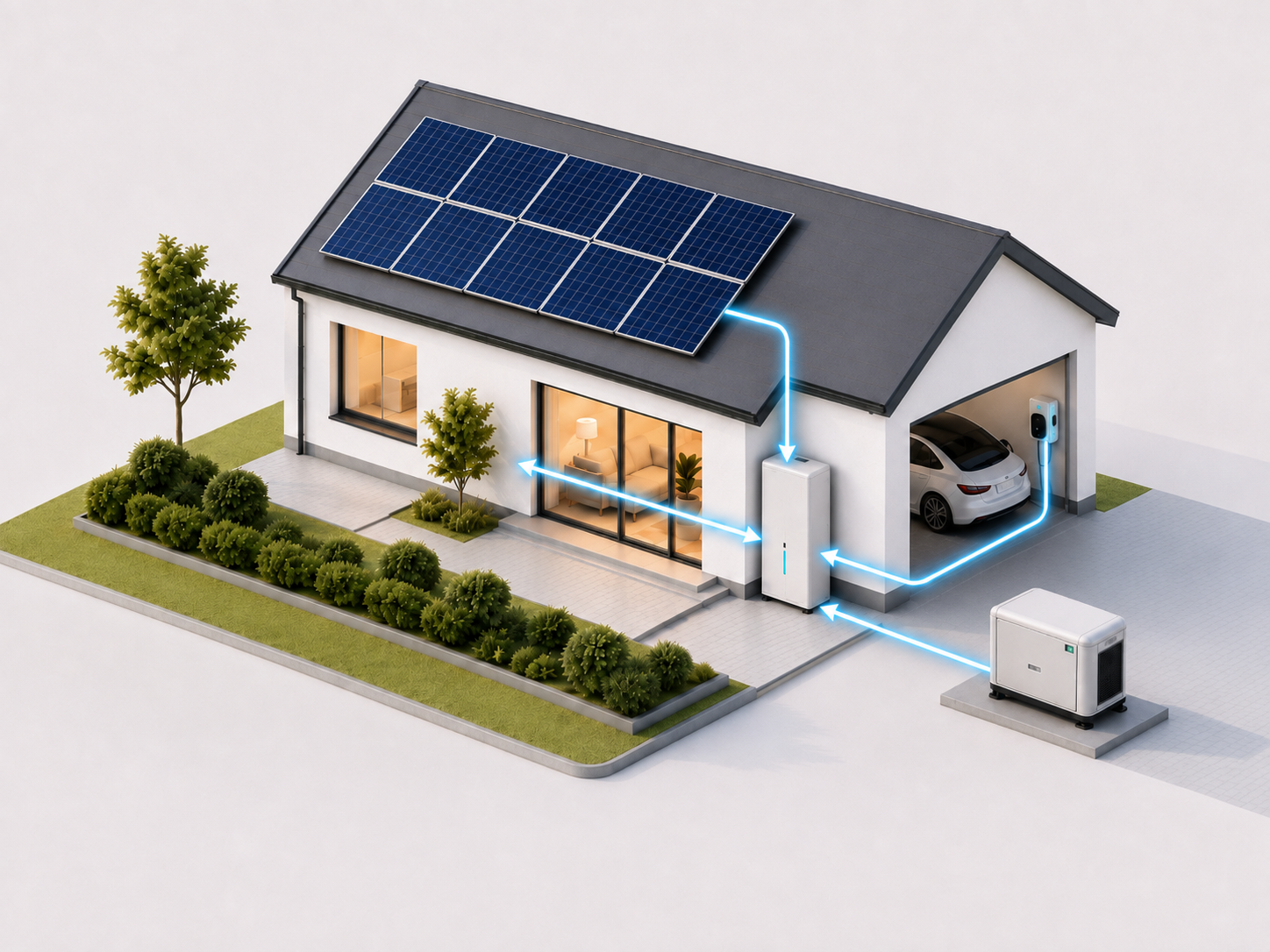
A solar battery backup system is often misunderstood as simply adding a large battery to a home solar installation. In reality, reliable backup power requires several components working together, including solar panels, battery storage, and backup-capable inverter. A generator or bidirectional EV charger may be added for extended backup.
Many homeowners assume solar panels will keep powering their homes during an outage, but according to the U.S. Department of Energy, standard grid-connected systems normally shut down when the grid fails.
To provide backup power, the system must first isolate the home from the utility network using a backup gateway, transfer switch, or similar device. This prevents unsafe backfeeding and allows the inverter to supply selected household loads.
The most reliable solar backup plans start by matching the system configuration to the actual backup requirement: outage duration, connected loads, and inverter output
What Types of System Configurations Are Available?
Home backup systems can combine solar panels, battery storage, electric vehicles, and generators in different ways. The right configuration depends on the required backup duration, household loads, existing equipment, and local grid reliability.
| Backup option | Best for | Key backup limitation |
|---|---|---|
| Solar-only system | Daytime solar self-consumption | Doesn’t support backup during grid outages |
| Battery-only system | Time-of-use electricity without solar panels | Less backup flexibility than solar-plus-battery system |
| Solar + battery | Evening use, short outages, essential-load backup | Backup depends on battery capacity and backup loads |
| Solar + battery + EV | Home with EV and bidirectional charger | Electric vehicle can serve as an extra backup source |
| Solar + battery + generator | Rural homes, weak-grid sites, multi-day outages | Requires generator integration and proper control |
A solar-plus-battery system is suitable for many homes because it can store surplus solar energy for use at night or during a blackout. Homes requiring longer backup may benefit from adding a bidirectional EV charger or generator, while battery-only systems can provide limited backup where rooftop solar is unavailable.
Can Solar-only Systems Work During Outages?
Solar panels alone cannot provide reliable backup power during a grid outage. A typical grid-connected solar system operates by sending electricity from the solar panels through an inverter to power household loads, with excess energy exported to the grid when production exceeds consumption.
When the grid goes down, the inverter disconnects from the utility connection. This prevents electricity from flowing back into the grid and protects maintenance personnel working on the electrical network. As a result, even if the solar panels are still producing energy, a standard grid-tied system will not continue supplying power to the home.
What Backup Needs Should Homeowners Consider?
The right solar battery backup system starts with understanding what needs to remain powered and how long during an outage. Different homes have different priorities, and the required system size changes significantly depending on the expected backup scenario.
In most cases, homeowners only need backup for essential loads such as lighting, refrigerators, Wi-Fi equipment, security systems, and medical devices. In these situations, a smaller system focused on critical loads can often provide a practical balance between backup capability and installation cost.
Whole-home backup requires a more detailed evaluation. Larger appliances such as air conditioning systems, heat pumps, water heaters, well pumps, kitchen appliances, and EV chargers can create much higher electricity demand. These loads may require both a larger battery and a higher-output inverter.
A bidirectional EV charger can provide an additional source of backup energy by allowing a compatible electric vehicle to discharge electricity back into the home. Because an EV battery is often much larger than a typical residential battery, it may help extend backup duration during an outage. However, vehicle-to-home functionality may not comply with local regulations or the EV manufacturer’s warranty requirements.
For rural properties or locations with unstable grids, outage duration becomes another important factor. If a power interruption can last for several days, relying only on a very large battery bank may become expensive because significant storage capacity is required. In these cases, a solar battery system combined with a diesel generator can provide a more practical solution.
Battery Capacity Is Important, But Inverter Power Determines What You Can Run
Battery capacity, measured in kilowatt-hours (kWh), determines how much energy is available. A larger battery can store more electricity and potentially support longer backup periods. Inverter power, measured in kilowatts (kW), determines how much power can be delivered at one time. It affects whether multiple appliances can operate simultaneously and whether the system can handle higher-demand equipment.
For example, a home may have enough stored energy in the battery to operate overnight, but if the combined load of an air conditioner, microwave, water pump, and other appliances exceeds the inverter’s output capability, the inverter may activate overload protection and disconnect the system.
A proper backup design should compare expected energy consumption with maximum simultaneous power demand. Homes with future plans for EV charging, heat pumps, or additional electrical equipment should consider these loads before selecting a battery system.
ESYsunhome’s Full-Range Backup Solutions
| System type | Models | Power | Expandable capacity | Best for |
|---|---|---|---|---|
| Single-phase Mid-power ESS | HM5 / HM6 / HM5-MAX / HM10 / HM12 | 5 kW / 6 kW / 10 kW / 10 kW / 12 kW | 5.12-30.72 kWh | Small and medium-sized homes |
| Three-phase ESS | HM10-H / HM15 / HM20 | 10 kW / 15 kW / 20 kW | 10.54-94.86 kWh | Large homes, small businesses |
| Bidirectional EV Charger | EV22 V2E | 22kW | – | Three-phase homes with EVs |
For residential backup, our single-phase systems are well suited to essential loads and small- to medium-sized homes, while our three-phase HM systems are designed for larger homes, farms, and small businesses with higher simultaneous power demand. A bidirectional EV charger can further extend backup capability in compatible three-phase homes with electric vehicles. For long-duration backup or weak-grid locations, generator integration becomes the key system consideration.
Common Mistakes When Choosing a Solar Battery Backup System
One common mistake is selecting a battery based only on storage capacity. A larger battery does not solve problems caused by insufficient inverter output or unsuitable backup wiring. Another mistake is assuming solar panels will automatically provide electricity during a blackout. Without a backup-capable inverter and proper grid isolation, standard solar systems will shut down during outages.
Oversizing batteries for rare long outages can raise cost; in rural or weak-grid sites, generator integration may be more practical. Finally, future electricity demand should not be ignored. EV charging, heating systems, home expansion, and additional electrical equipment can change the required backup capacity over time.
FAQ
Can solar panels power my home during a blackout?
Solar panels can support backup operation only when they are connected to a suitable backup system with battery storage, a backup-capable inverter, and proper grid isolation. Standard grid-connected solar systems normally shut down during outages.
Is a bigger battery always better?
A larger battery is not always the best choice. The system should match the home’s backup loads, outage duration, inverter output, and future energy requirements.
Do I need a generator with solar battery backup?
It depends on the expected outage conditions. Battery storage may be sufficient for shorter interruptions, while rural properties or locations with multi-day outages may benefit from generator integration.
How much battery capacity does a home need?
The required capacity depends on electricity consumption, critical loads, desired backup duration, and whether the goal is essential backup or broader household coverage.
Conclusion
A reliable solar battery backup system is not defined by battery size alone. It must balance storage capacity, inverter output, backup loads, outage duration, grid isolation, and future energy needs. By selecting the right combination of solar, batteries, EV charging, and generator support, homeowners can build a safer, more practical system that keeps required loads running when the grid goes down.