









Most European homes need a 5 kWh to 15 kWh usable battery. A 20–30+ kWh is better for whole-home backup, large homes, or off-grid use. The battery size depends on the family’s consumption pattern, backup requirement, and whether the family uses dynamic electricity tariffs.
Battery Size Basics: Rated Capacity Vs Usable Capacity
Battery size is usually measured in kilowatt-hour (kWh). Rated capacity is total energy stored, while usable capacity is energy available to household load. The difference depends mainly on Depth of Discharge (DoD). For example, a battery module with a 10 kWh rated capacity and 90% DoD has a usable capacity of around 9 kWh.
Step 1: Find Your Daily kWh Use
Start with your electricity bill. Find the total kWh used during the billing cycle, then divide it by the number of days. You need to take peak periods into account. Air conditioning and electric heating push daily use sharply higher in summer and winter. Size from a mild-month bill and you risk undersizing for the season you most need backup.
📐 Formula:
Daily kWh use = total bill kWh ÷ billing days
📎 Example:
900 kWh ÷ 30 days = 30 kWh per day
Take peak season demand into account. Air conditioning and electric heating push daily use sharply higher in summer and winter. Across the EU, Eurostat reports that space heating alone accounted for about 62.5% of household final energy use in 2023.
Step 2: Choose Your Backup Goal
The right home battery size depends on your goal, not just your home size. Most systems fall into one of three categories:
| Goal | How to Size It |
|---|---|
| Backup power | Battery Size > Load Power * Backup Hours |
| Solar self-consumption | Solar Generation – Daytime Usage < Battery Size < Evening Usage |
| Off-grid autonomy | Battery Size > 2 * Daily Usage |
Use the right sizing logic for each goal:
- Backup power: size by critical load power × outage hours
- Solar self-consumption: size by solar surplus and evening or night demand
- Off-grid: size by daily use × autonomy days, then check solar recharge and inverter peak power
Step 3: Calculate Battery Size by Backup Hours
For backup power, estimate how many hours you want the battery to run your selected loads.
📐 Formula:
Battery capacity needed = Load Consumption (kW)× backup hours (h)
| Load consumption (kW) | Backup target (h) | Capacity needed |
|---|---|---|
| 5 | 1 | 5 kWh |
| 5 | 3 | 15 kWh |
🧷 Note: when deciding between whole-home vs. partial backup, use only the daily kWh of essential loads for partial backup, or your full daily electricity use for whole-home backup. This formula is only a rough estimate; final sizing should be based on your actual backup loads, usable kWh capacity, and kW output.
How long do real outages last? In Australia, the average customer experiences roughly 200 minutes (about 3.3 hours) of outages per year on regulated networks, per the AER 2024 Electricity and Gas Networks Performance Report. Across Europe, unplanned outage durations vary widely between countries, generally from under 30 minutes to several hundred minutes per customer per year, according to the CEER-ECRB Benchmarking Report on the Quality of Electricity and Gas Supply. This means small to mid-size batteries cover most everyday outages, while severe storms or extended grid events are what push some homes toward larger or stackable systems.
How Dynamic Electricity Tariffs Affect Battery Size
Dynamic electricity tariffs change battery sizing from simple solar storage to price-based energy management. With a standard tariff, the battery mainly stores daytime solar surplus for evening use. With a dynamic tariff, the battery can also charge from the grid when electricity is cheap and discharge during expensive peak hours. This means sizing should consider not only backup hours and solar surplus, but also evening peak consumption and tariff spread. For homes using dynamic tariffs, adding a 2–5 kWh buffer above a solar-only calculation can help store both solar energy and low-price grid electricity.
What We See in Real Installations: A 15 kWh Home Battery Case
Using our own residential installation data, a 15.36 kWh class system is often a practical middle ground for homes with higher electricity demand but limited space for larger battery setups.
One example comes from our residential projectin Zeewolde, Netherlands.
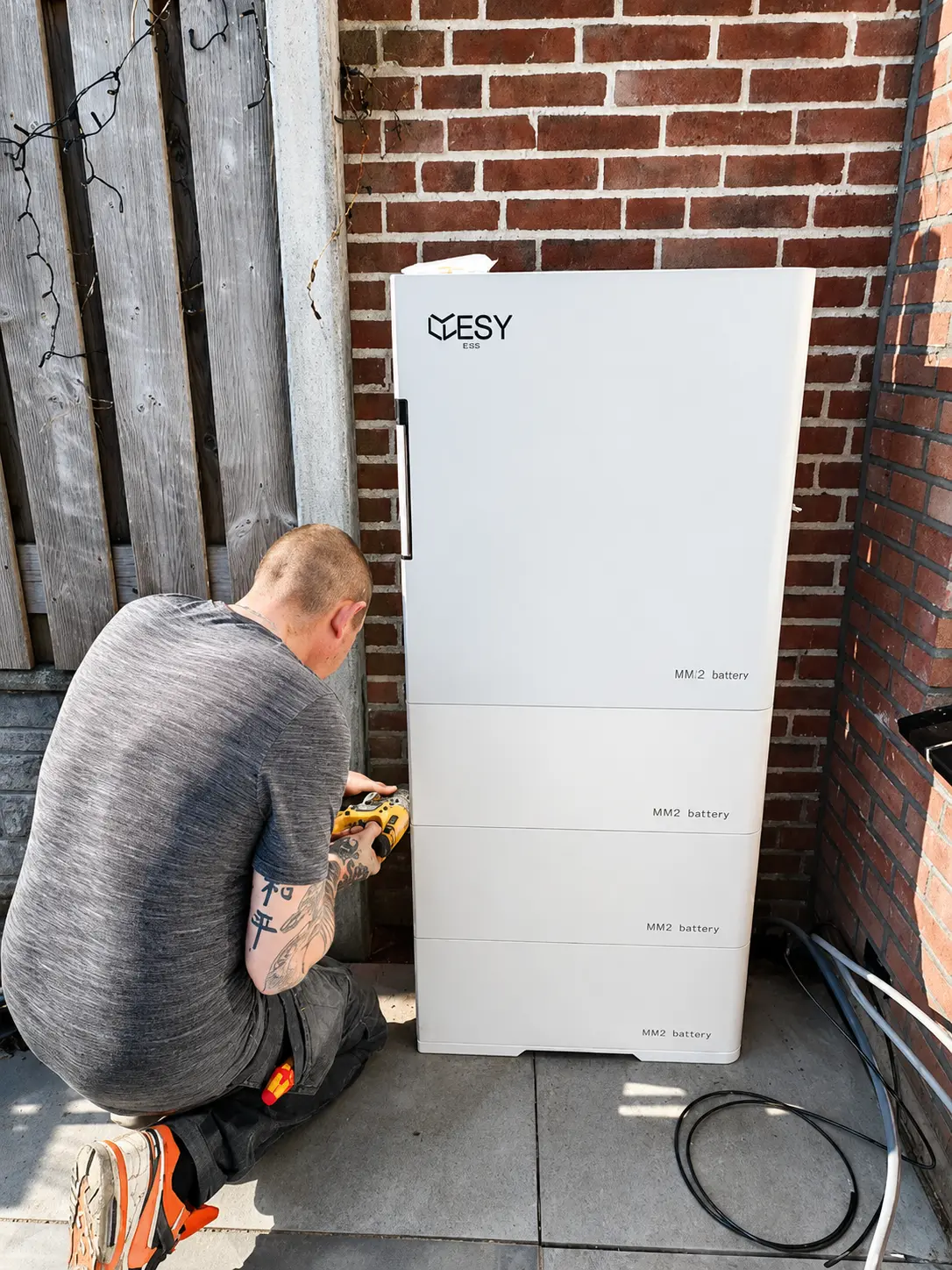
| Project Detail | Case Data |
|---|---|
| Ubicación | Zeewolde, Netherlands |
| Challenge | Electric heating and EV charging increased household demand, while local grid rules limited solar export |
| Configuration | HM12 system with 3 battery modules |
| Battery Capacity | 15.36 kWh |
| Outcome | Solar self-consumption, AI mode, dynamic-tariff optimization, and anti-backflow protection |
Fuente: ESYsunhome first-party residential case data, 2026.
What this tells us: every home is different, and so is every sizing answer. A certified local installer can review your daily load, solar setup, and backup goals on site, then recommend the right HM configuration for your home and local grid rules.
→Find a Certified Installer Near You
Preguntas frecuentes
Is a 10 kWh battery enough for a house? It depends on your loads. A battery 10kWh in size comfortably covers essentials like lights, Wi-Fi, and a fridge for many hours. It will not run central AC or electric heating across a long outage on its own.
How long will a home battery last during a power outage? For essentials, a mid-sized battery can last many hours to a full day. For heavy loads, the same battery may last only a few hours. Most ordinary outages are short, but 2024 saw an unusually high 11-hour average due to major storms, per the EIA.
Is a bigger battery always better, or am I overpaying? Bigger is not always better. If your usage or solar surplus cannot use the extra capacity, you pay for energy you never store. Size to real needs and pick a modular system you can expand.
References
- Australian Energy Regulator. “2024 Electricity and Gas Networks Performance Report.”
- Eurostat. “Energy consumption in households.”
- Council of European Energy Regulators (CEER) and Energy Community Regulatory Board (ECRB). “7th CEER-ECRB Benchmarking Report on the Quality of Electricity and Gas Supply.”
About the Publisher
ESYsunhome is an advanced energy solutions and product provider focused on clean energy for homes and businesses.
Its residential HM all-in-one systems are tested to international standards including TÜV, CE, IEC 62109, IEC 62619, and EMC, and meet regional grid-connection codes such as Australia’s AS/NZS 4777.2 and Germany’s VDE-AR-N 4105.
The company is an UNGM-registered supplier and provides localized support and 24/7 service across its global markets.
Last updated: May 2026 Reviewed by: ESYsunhome Energy Storage Engineering Team