 Global-EN

The EUs' Energy Evolution: When Momentum Meets Complexity
Europe is in the midst of a historic energy transformation. As it charges toward climate neutrality by 2050, two forces are leading the wave: the mass adoption of electric vehicles (EVs) and renewable energy.
The EU's electric vehicle market has transitioned from early-stage development to mass-market scaling over the last decade. As illustrated in Figure 1, annual registrations remained relatively modest between 2015 and 2019. From 2020 onward, registrations increased sharply, exceeding 1 million units in 2020 and peaking at 2.6 million in 2025.
Figure 1: the EU's New Registration of Electric Vehicles, 2015-2025
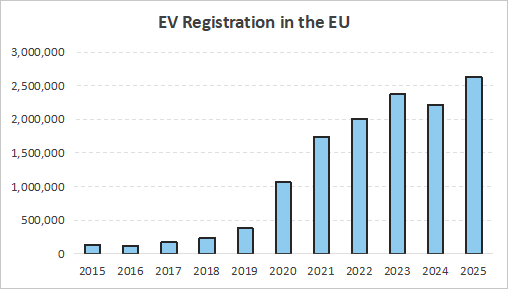
Source: European Environment Agency & EUROMETAL
The energy mix follows a similar trajectory. In Q2 2025, renewable energy accounted for 54.0% of net electricity generation in the EU, up from 52.7% in the same period of 2024. This growth was driven mainly by solar power, which produced 122,317 GWh during the quarter and made up 19.9% of the EU’s total electricity generation [1]. In June 2025, solar power takes a top spot in the EU's electricity generation for the first time ever, and generated 22.1% of EU electricity (45.4 TWh), more than any other power source [2].
While these trends represent a significant leap forward, this "dual adoption" of EVs and solar introduces new complexities. With more EVs on the road, grid instability increases—especially during peak-load hours when residents return home and plug in their vehicles. In contrast, solar generation peaks during daylight hours, often when homes are unoccupied and electricity demand is low.
EV DC Charging: The Key to Reducing Range Anxiety
In today’s fast-moving global EV market, both AC and DC power act as the “fuel” that keeps EVs running. But as EV adoption accelerates, charging speed has become a key influential factor to customer satisfaction. In this context, DC charging plays a vital role in easing one of the biggest barriers to EV adoption: range anxiety. DC charging delivers a clear speed advantage over AC charging, largely due to the fundamental difference of current type. DC charging delivers high-voltage direct current straight to the battery with minimal intermediate steps. By comparison, AC charging is more like an “electricity transfer station,” where power must first pass through the vehicle’s on-board charger to convert AC into DC [3].
Bidirectional EV DC Charger + BESS: a Smarter Way to Electrify Homes
To address aforementioned complexities, ESY SUNHOME introduced its Vehicle-to-Energy (V2E) bidirectional EV DC charger with battery energy storage system. This unified ecosystem synchronizes PV generation, household load consumption, dynamic electricity tariffs, and electric vehicle, and then transforms the EV from a passive energy consumer to asset via AI. This architecture enables the following closed-loop energy cycle:
- Utilizing V2E DC charging stations allows you to bypass grid power limitations and charge the EV more quickly and efficiently via solar energy, battery system, and even power grid;
- Leveraging solar energy, supplemented by power grid, to charge the EV, optimized for cost and sustainability;
- Discharging from the EV to feed back into the power grid during on-peak periods, enhancing grid stability;
- Supplying household load consumption via the EV in peak-tariff hours to reduce electricity costs and serve as a backup power source during outages.
Why Choose ESY SUNHOME?
Choosing ESY SUNHOME is not just about adopting advanced technology—it’s about working with a long-term energy partner that understands the European market and stands close to its customers. We believe that a solution only delivers real values when it is backed by strong local presence, proven reliability, and intelligent control. That's what makes us stand out:
- Premium Local Support: With established subsidiaries in Europe, we ensure timely technical support, faster project deployment, and streamlined logistics;
- Safe & Reliable: Designed to meet the highest safety standards, the charging station features an IP65-rated protection, ensuring reliable performance across diverse European climates. It incorporates comprehensive safety protection measures, including high-frequency transformer isolation, insulation monitoring, surge protection, leakage current detection, et al.;
- Extensive Compatiability: Universal support for a wide range of EV models with charging voltage of 200-1000V and discharging voltage of 300-1000V;
- Intelligent: At the heart of the system is a sophisticated energy management platform. It enables remote scheduling of charging and discharging, and OTA software upgrades for continuous feature enhancement.
Reference
[1] https://ec.europa.eu/eurostat/web/products-eurostat-news/w/ddn-20250929-3
[3] https://digitalpower.huawei.com/en/blogs/why-is-dc-charging-faster-than-ac