









Australia does not yet have a robust nationwide rebate specifically for C&I battery rebate. The federal battery program mainly supports systems below 100 kWh, leaving most larger commercial and industrial projects outside its scope. For larger commercial and industrial projects, NSW has the clearest state pathway, with PDRS BESS3, BESS4 and BESS5 starting on 1 September 2026. This marks an important shift towards state-led support, but a consistent national framework has yet to emerge.
State Battery Rebate for Businesses
State battery support differs sharply by location. NSW has the most direct C&I battery certificate pathway in 2026. ACT, NT, WA and VIC also have relevant programs, but their scope is narrower. Some apply to small businesses, some to multi dwelling properties, and some to broader energy upgrades.
NSW: PDRS BESS3, BESS4 and BESS5
NSW is the main state to watch for commercial battery incentives in 2026. The PDRS Store and Shift Capacity method lists BESS3, BESS4 and BESS5 as new battery activities starting on 1 September 2026. The scheme creates Peak Reduction Certificates, or PRCs, for eligible behind the meter battery systems that reduce peak demand.
| Activity | Target group | Equipment requirements | Minimum co payment |
|---|---|---|---|
| BESS3 | Apartment buildings with at least 4 dwellings. |
|
$1,000 per implementation. |
| BESS4 | Small and medium businesses, excluding residential buildings and data centres. |
|
$5,000 per implementation. |
| BESS5 | Commercial and industrial businesses. |
|
Final scheme detail was still being confirmed in the published guidance reviewed for this article. |
For NSW BESS5 style projects, the capacity class may be relevant, although formal eligibility still depends on usable capacity, approved product treatment, installation method, approvals and the final PDRS requirements.
ACT: Sustainable Business Program
The ACT pathway is mainly a business efficiency support program. The Sustainable Business Program offers free onsite assessment, technical advice and rebates for eligible ACT businesses operating from commercial premises. Current ACT material says eligible businesses may access up to $10,000 for energy and water efficiency upgrades and up to $3,000 for EV charging, with business co-contribution required.
NT: Solar for Multi Dwellings Grant Scheme
The NT program is relevant when the site is a qualifying multi dwelling property. The Solar for Multi Dwellings Grant Scheme provides up to $7,500 excluding GST per dwelling and can cover up to 50% of total installation costs for shared solar PV, solar sharing technology, smart meters and battery storage systems.
This is more relevant to unit management corporations and shared property structures than a general factory or warehouse battery project. For apartment scale or shared load projects, a hybrid design can be valuable because control, metering and user benefit allocation often matter as much as the battery cabinet.
WA: Residential Battery Scheme
The WA scheme is mainly residential. The current WA Residential Battery Scheme applicant page lists rebates up to $1,300 for Synergy customers and $3,800 for Horizon Power customers, with VPP participation required. Home businesses may be relevant where the property is mainly residential, but ordinary C&I sites should treat this as outside their core commercial rebate planning.
VIC: Victorian Energy Upgrades Program
Victoria supports businesses through the Victorian Energy Upgrades Program, which provides discounts on approved energy saving products through accredited providers. For solar PV, Victoria’s commercial and industrial solar PV discount page states that eligible systems are from 30 kW to 200 kW. Battery storage for businesses is mainly addressed through the federal Cheaper Home Batteries Program when the system fits that federal size and solar connection framework.
How It Works
The Flow of PRC Certificates
NSW PDRS uses PRCs. The IPART PRC guidance states that only an Accredited Certificate Provider can create PRCs, and the ACP must be nominated as the capacity holder before certificate creation. The ACP registers PRCs, sells them to scheme participants, and those participants surrender certificates to meet annual targets.
Grid Interaction and Peak Shifting
A C&I battery works by moving energy into higher value hours. It can charge from solar during the day, then discharge during peak price periods or demand spikes. In NSW BESS4 and BESS5, the requirement for Demand Response Aggregator controllability shows the direction of the market: batteries are being valued as flexible grid assets as well as onsite energy equipment.
Is C&I Solar Worth Considering in 2026?
C&I solar is worth considering in 2026 when a site has usable roof or land, steady daytime load, evening peak exposure, backup needs or electrification plans. Solar can reduce daytime grid imports. Battery storage can move more solar energy into peak periods, backup windows or demand management programs.
For small business sites, the federal battery program may improve the economics of a compact solar battery system. For larger sites, the value usually comes from several areas working together: solar self consumption, peak shaving, backup resilience, demand response readiness and state certificate support where available.
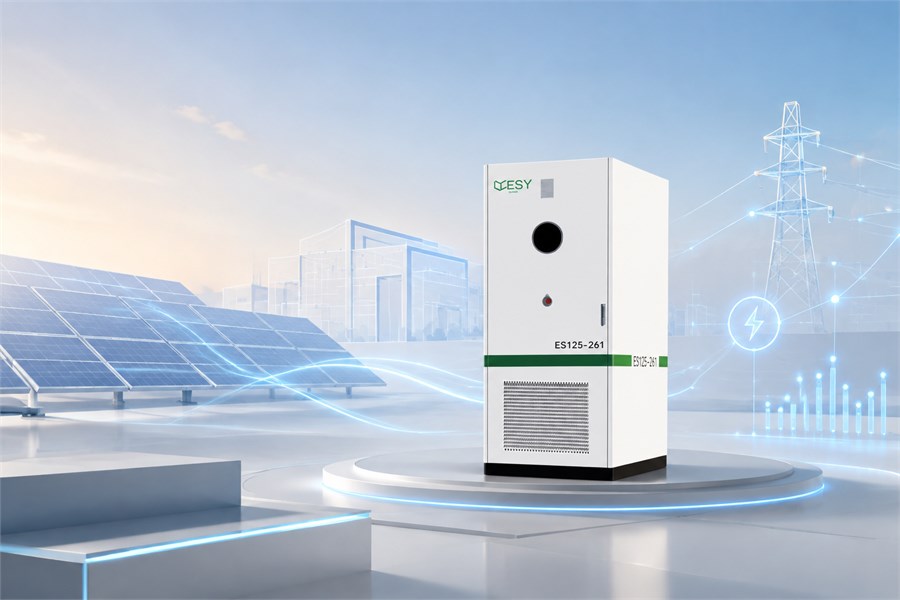
ESY supports these projects with C&I storage products for different site conditions. Our ES125-261 ESS delivers 125kW power with a 261kWh battery cabinet for commercial energy storage applications, including solar self consumption, peak shaving, backup support and scalable capacity. The ES130-261 PV storage diesel hybrid system supports PV + storage + diesel generator + charging solutions.
We are also building local support in Australia through our Smart Energy Answers partnership. This gives installers, businesses and end users better access to field service, engineering support, commissioning guidance and after sales response. For C&I projects, that support can be just as important as the rebate itself.
常见问题
Does Australia have a nationwide rebate for C&I batteries?
Australia does not currently have a comprehensive nationwide rebate specifically for medium- and large-scale C&I battery systems. The federal Cheaper Home Batteries Program covers eligible residential and non-residential batteries with a nominal capacity of 5-100 kWh, but only the first 50 kWh of usable capacity can receive Small-scale Technology Certificates. Larger C&I systems generally fall outside the federal battery program.
What is the difference between BESS3, BESS4 and BESS5?
BESS3 supports apartment buildings with at least four dwellings and covers battery systems with more than 20 kWh and up to 200 kWh of usable capacity. BESS4 covers batteries installed at small and medium-sized business premises, excluding residential buildings and data centres, with a combined usable capacity of more than 20 kWh and up to 200 kWh. BESS5 is designed for larger commercial and industrial systems with more than 200 kWh and up to 30 MWh of usable capacity, although incentives apply only to the first 10 MWh.
Are off-grid C&I batteries eligible under the NSW PDRS?
No. The battery must be installed behind the meter at a site connected to the NSW electricity network. It must also receive the necessary network and planning approvals and be fully connected and operational before certificates can be created.